AI-Native SEO Agency

Be found on Google. Be chosen by AI.

One evidence-led program for organic rankings, AI citations, brand recommendations, and measurable demand.

Engagements from $3,500/month · India and Philippines · Strategy, implementation, and measurement

Connected discovery system

One evidence base. Six surfaces.

Measured
TPS

Google & Bing

Rank and earn clicks

Google AI Overviews & AI Mode

Become a supporting source

ChatGPT Search

Be discoverable and cited

Perplexity

Earn source inclusion

Gemini

Clarify the entity and evidence

Claude

Support live-web retrieval

The principle

Publish information people trust, machines can retrieve, and independent sources can corroborate.

One accountable program

TheProjectSEO is an AI-native SEO agency for companies that need one accountable program across Google, Bing, AI Overviews, ChatGPT, Perplexity, Gemini, Claude, and other generative engines. We combine technical search engine optimization, content, authority, GEO, AEO, entity work, and measurement to improve organic rankings, AI citations, brand recommendations, and qualified demand.

The short answer

What does an AI-native SEO agency actually do?

Reviewed by Aditya Aman

Founder & SEO Consultant · Updated July 27, 2026

An AI-native SEO agency helps a business become easier to find, understand, verify, and choose across organic results and AI-generated responses. It does this by connecting technical accessibility, information architecture, useful pages, structured facts, evidence people can trust, prompt research, and outcome measurement in one operating system.

The phrase AI-native should describe the delivery model, not a fashionable service label. We use automation where it improves coverage and consistency: processing crawl data, clustering large query sets, finding internal-link opportunities, comparing a draft with a live competitor corpus, checking structured information, and detecting performance changes. Human practitioners still choose the strategy, validate the evidence, edit the work, and own the release decision.

The phrase SEO and GEO agency describes the market problem. A buyer may start with a conventional query, continue with a detailed prompt, compare vendors inside a generated answer, and visit only the sources that appear credible. A modern program must support that whole journey without pretending traditional results and every AI platform use the same retrieval or ranking system.

Key takeaways

  • SEO and GEO are not competing channels. The same accessible, useful, well-supported source material can contribute to both.
  • AI-native describes how the work operates: data-connected research, reusable workflows, human quality gates, implementation, and continuous measurement.
  • A mention, a citation, a referral visit, and a conversion are four different events. We report them separately.
  • This page covers the complete agency-intent cluster. Platform and discipline pages provide deeper implementation detail without duplicating the proposition.

First-party proof

What evidence shows the model working in both Google and AI answers?

Expressway.PH and TaxCalculator.com.ph are owned projects with direct access to their underlying performance data. That makes them useful public examples: we can show the reporting period, identify the source of each metric, and distinguish an observed result from a causal claim.

Expressway.PH · Search publication

A practical road resource becoming a source across organic and AI results.

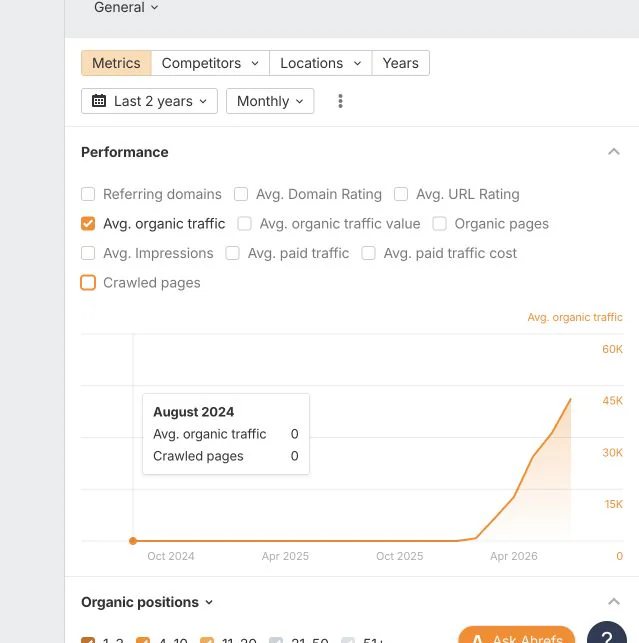
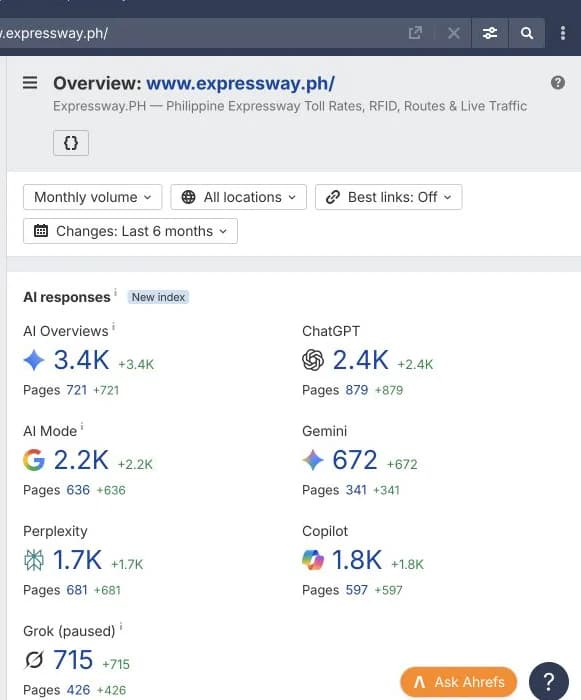
Expressway.PH resolves specific Philippine driving tasks: toll rates, routes, RFID guidance, and road information. Its architecture is built around real journeys rather than a stream of disconnected posts. Ahrefs showed strong organic reach and thousands of tracked appearances across AI Overviews and ChatGPT in the July 2026 capture.

49.2K
Estimated monthly organic traffic
6.8K
Organic keywords
3.4K
AI Overview responses
2.4K
ChatGPT responses

Source: Ahrefs Site Explorer capture supplied July 2026. AI totals refer to Ahrefs' tracked response index, not unique people or visits.

Reserved for the approved Ahrefs screenshot with Avg. organic traffic selected and the organic keyword trend visible.

Ahrefs
Verified capture
Ahrefs two-year average organic traffic chart for Expressway.PH showing a strong upward trend.
Expressway.PH — Ahrefs organic traffic and keyword trendTwo years · monthly
Captured 28 July 2026

Reserved for the approved three-month Search Console screenshot showing total clicks, total impressions, and the full trend.

Measurement
Visual explainer
TaxCalculator.com.ph — Google Search Console performanceBaseline, observation and decision model
Prepared July 2026

TaxCalculator.com.ph · Utility-led growth

A focused utility gaining demand from a zero-authority baseline.

TaxCalculator.com.ph turns a difficult Philippine tax task into a clear, usable calculation experience. The project launched in June 2026. Its latest three-month Search Console view showed 32,300 impressions and 335 clicks while Ahrefs still reported zero referring domains in the supplied capture.

32.3K
Search Console impressions
335
Search Console clicks
3 months
Selected reporting window
0
Referring domains in Ahrefs

Sources: Google Search Console totals and Ahrefs overview supplied July 2026. Early movement is encouraging, not a promise of future performance.

Shared language

How are SEO, GEO, AEO, and LLM SEO different?

These labels describe related outcomes, not four isolated marketing departments. A credible AI-first SEO agency identifies which mechanic is relevant, then coordinates the work around one business objective. Answer engines can select different sources even when a user's intent is similar.

Our umbrella term is AI search optimization. The engagement includes conventional organic optimization because discoverable, indexable, authoritative source pages remain essential.

TermMeaningPrimary focusTypical work
SEOSearch engine optimizationOrganic result visibility, qualified clicks, and conversionsTechnical eligibility, intent alignment, pages, links, usability, and measurement
GEOGenerative engine optimizationSource inclusion, citations, and accurate representation in generated responsesExtractable answers, evidence, entities, topical depth, corroboration, and prompt testing
AEOAnswer engine optimizationBecoming a concise answer or supporting passageQuestion-led sections, direct definitions, structured facts, and supporting explanation
LLM SEOAn informal market termBrand discovery and recommendation in LLM-powered productsPlatform access, source quality, entity clarity, third-party validation, and response monitoring

Platform strategy

How does optimization change across Google, ChatGPT, Perplexity, Gemini, and Claude?

The common foundation is accessible, useful, verifiable information. The platform layer changes how we test eligibility, observe source selection, and measure the result. Strategies for ChatGPT, Gemini, Perplexity, Claude, and Google therefore share a foundation but not an identical checklist. We avoid universal “LLM ranking factors” claims when a provider has not published them. Different platforms and engines require different tests, and those tests help us separate access problems from evidence problems. The engines also change, so the observation date always stays attached to the result.

Rank and earn clicks

Google & Bing

Technical eligibility, intent-matched pages, internal links, authority, and a useful experience remain the foundation across Google and Bing.

  • Crawl, rendering, indexation, and template QA
  • Keyword-to-page architecture and intent alignment
  • Internal linking, structured data, and page experience
  • Search Console and Bing Webmaster Tools measurement
Become a supporting source

Google AI Overviews & AI Mode

Google states that the same core best practices apply to its AI features. Pages must be indexed and eligible to appear with a snippet.

  • Complete coverage of the question and its subtopics
  • Concise answer blocks supported by deeper explanation
  • Visible evidence, authorship, and accurate structured data
  • Optimization for related-query fan-out, not one phrase
Be discoverable and cited

ChatGPT Search

OpenAI says public sites can appear in ChatGPT search and advises publishers not to block OAI-SearchBot when they want content surfaced.

  • OAI-SearchBot access and server-log verification
  • Pages that state facts, scope, dates, and source context
  • Brand and product entities corroborated off-site
  • ChatGPT referral tracking separated from mentions
Earn source inclusion

Perplexity

Perplexity publishes separate crawler guidance for search discovery and user-requested retrieval. Access is only the eligibility layer.

  • Crawler, WAF, and CDN accessibility checks
  • Citation-worthy pages with primary information
  • Stable URLs, clear headings, and extractable passages
  • Prompt-level source and competitor monitoring
Clarify the entity and evidence

Gemini

We strengthen the same accessible source material Google can discover while monitoring how Gemini describes and recommends the brand.

  • Consistent organization, product, and expert facts
  • First-party data linked to its methodology
  • Topic clusters that resolve adjacent questions
  • Response monitoring by prompt, market, and date
Support live-web retrieval

Claude

We treat Claude as a distinct answer surface: test the prompts buyers use, inspect selected sources, and improve the evidence available on the open web.

  • Repeatable commercial and informational prompt sets
  • Clear passages that retain meaning when extracted
  • Independent references that verify important claims
  • Mention, citation, referral, and conversion tracking

Complete service scope

What does our AI search SEO agency deliver?

We do not rename a content retainer “GEO.” The diagnosis determines the disciplines and strategies required. A rendering problem needs engineering; an incomplete topic needs better information; an unverified claim needs evidence and independent authority; an unclear result needs stronger measurement. This evidence-driven scope helps the team invest in the constraint that is actually limiting performance.

01

Market, SERP, and prompt research

We map how buyers discover, compare, and validate options across conventional results and generated answers. The output joins keyword demand, prompt themes, visible competitors, cited sources, business value, and the page required to compete.

  • Search-demand and intent map
  • Buyer-prompt library
  • SERP and citation-source corpus
  • Prioritized opportunity model
02

Technical SEO and retrieval

We find the engineering conditions that prevent pages from being crawled, rendered, indexed, understood, or retrieved. Recommendations identify the affected template, expected impact, implementation owner, and acceptance test.

  • JavaScript and rendering diagnostics
  • Crawl and indexation controls
  • Core Web Vitals and page experience
  • Bot, CDN, and server-log validation
03

Information architecture and entities

We make the relationship between the company, people, services, evidence, industries, and locations explicit. Clean architecture reduces ambiguity for users and gives crawlers reliable paths to the pages that matter.

  • Entity and relationship mapping
  • Navigation and taxonomy design
  • Internal-link graph improvement
  • Visible facts aligned with schema
04

Content strategy and production

We create or improve commercial pages, supporting guides, comparisons, tools, and original research. A page is judged on whether it resolves the task, adds defensible information, and earns a place in the wider topic—not on word count alone.

  • SERP-corpus content briefs
  • Entity and subtopic coverage
  • Expert interview integration
  • Editorial review and refresh cycles
05

Generative engine optimization

Our GEO work makes important information easier to extract, attribute, verify, and reuse in an answer. It includes direct definitions, answer-first passages, supporting depth, source context, authorship, dates, and strong corroboration.

  • GEO and AEO page architecture
  • Citation-ready source sections
  • Claim-to-evidence review
  • Platform-specific retrieval checks
06

Authority and digital PR

Owned pages cannot independently validate every claim they make. We develop relevant editorial links, expert contributions, source relationships, and brand mentions that strengthen discovery while providing third-party corroboration.

  • Authority-gap analysis
  • Relevant editorial link earning
  • Expert-led digital PR
  • Unlinked mention recovery
07

LLM visibility tracking

A fixed prompt panel gives the team a repeatable view of mentions, recommendations, citations, and competitors. We preserve the model, prompt, location, date, and response because generated answers are variable observations—not permanent rankings.

  • Prompt taxonomy and test controls
  • Brand mention and citation logging
  • Competitor share-of-answer
  • Source and response change detection
08

Analytics and revenue attribution

We connect visibility to what happened next. Search Console, analytics, CRM outcomes, and AI referrals are reported in separate layers so citations are not confused with visits and visits are not confused with qualified demand.

  • GSC, GA4, and BigQuery pipelines
  • AI referral channel definitions
  • Lead and pipeline attribution
  • Decision-focused reporting

AI-first operating system

How do we use AI without producing generic content?

AI is most valuable when it operates inside a controlled chain of context, constraints, checks, and accountable decisions. The objective is better analysis and faster implementation—not maximum output.

This homepage itself was rebuilt through that process: a live eight-page competitor corpus, deterministic term scoring, entity extraction, a consolidated brief, editorial judgment, and a second scoring pass.

  1. 1. Ground the context

    Search Console, analytics, rank data, crawl output, CRM definitions, existing pages, product facts, and expert input establish what is known.

  2. 2. Build the live corpus

    We study the pages, result features, cited sources, headings, entities, questions, and content formats already competing for the target task.

  3. 3. Score the opportunity

    A local Python-based content optimizer measures topic and entity coverage against the live corpus. Its score informs editing; it never overrides accuracy or user value.

  4. 4. Add practitioner judgment

    A specialist chooses the page type, argument, evidence, internal relationships, and commercial action. Generic term recommendations are rejected when they add no meaning.

  5. 5. Implement and verify

    Copy, code, structured data, links, analytics, and technical changes are reviewed in the rendered page—not approved in an isolated document.

  6. 6. Preserve the learning

    The released version, baseline, later movement, and decision history remain connected so future work compounds instead of restarting from a slide deck.

First 90 days

What happens after you hire TheProjectSEO?

The exact backlog changes by site, but the operating sequence does not: establish a reliable baseline, release the highest-value foundation and page improvements, expand evidence and authority, then compound what the data supports. Within the first three months, the aim is to replace assumptions with a working evidence loop.

  1. 01

    Days 1–30

    Baseline and diagnosis

    We connect the available data, crawl the site, inspect templates, inventory current pages, map entities, research priority result sets, and build the first controlled prompt panel. The month ends with an evidence-backed backlog—not a generic audit checklist.

    Typical output: Technical findings, organic baseline, AI-answer baseline, competitor corpus, page inventory, quick wins, and a sequenced implementation plan.

  2. 02

    Days 31–60

    Foundation and priority pages

    Engineering fixes and content work begin together. We repair discovery and rendering issues, tighten site architecture, improve the pages closest to revenue, add missing proof, and align visible information with structured data.

    Typical output: Released fixes, upgraded commercial pages, new briefs, internal-link changes, entity corrections, and implementation QA.

  3. 03

    Days 61–90

    Coverage and authority

    The program expands into supporting questions, comparisons, original assets, and off-site validation. We rerun the controlled prompt panel and compare source selection, mentions, rankings, impressions, clicks, and conversions against the baseline.

    Typical output: Topic-cluster releases, authority activity, citation comparison, organic movement, and a second-quarter opportunity model.

  4. 04

    Ongoing

    Compound what the evidence supports

    Each cycle separates shipped work from observed movement and business outcomes. Winning page patterns are scaled; weak assumptions are revised; declining pages are refreshed or consolidated; new result formats and platform behavior are tested.

    Typical output: Weekly operating view, monthly decision review, content refreshes, new experiments, and a transparent record of what changed.

Deliverables

What will your team actually receive?

Advice is packaged so somebody can implement and verify it. Every important recommendation includes its evidence, priority, dependency, owner, and completion condition.

The output is not a deck of observations. It is an operating backlog.

AssetWhat it containsCadence
Opportunity modelKeywords, prompts, cited sources, competitors, value, feasibility, target URLInitial build; monthly update
Technical backlogAffected template, evidence, impact, owner, implementation notes, acceptance testInitial audit; sprint updates
Page and topic architectureCommercial pages, supporting questions, consolidation, internal links, proof requirementsQuarterly plan; ongoing release
Content brief and QA recordSERP corpus, entity coverage, outline, sources, claims, reviewer, change notesPer priority page
AI-answer observation panelPlatform, prompt, date, response, mentions, citations, competitors, source URLsBaseline plus agreed reruns
Decision reportReleased work, visibility movement, traffic, qualified demand, interpretation, next actionMonthly

Measurement

How do we connect rankings and AI citations to revenue?

We report a chain of evidence instead of compressing everything into one visibility score. A page can be eligible but unseen, visible but unclicked, cited but never visited, or visited without producing qualified demand. Each state requires a different decision. We run the controlled observation panel over time so a single generated response is never mistaken for a trend.

01

Eligibility

Crawl access, rendering, indexation, snippet eligibility, bot access, valid structured information

02

Visibility

Impressions, positions, non-brand coverage, answer mentions, citations, source inclusion, competitor share

03

Engagement

Organic clicks, ChatGPT referrals, other identifiable AI referrals, landing-page behavior

04

Qualified demand

Forms, calls, demos, leads, assisted conversions, lead quality, sales-accepted opportunities

05

Commercial impact

Pipeline, closed revenue, acquisition efficiency, payback, and the confidence of the attribution

Reserved for an approved dashboard showing its selected metrics, reporting window, and comparison period.

Google Search Console
Verified capture
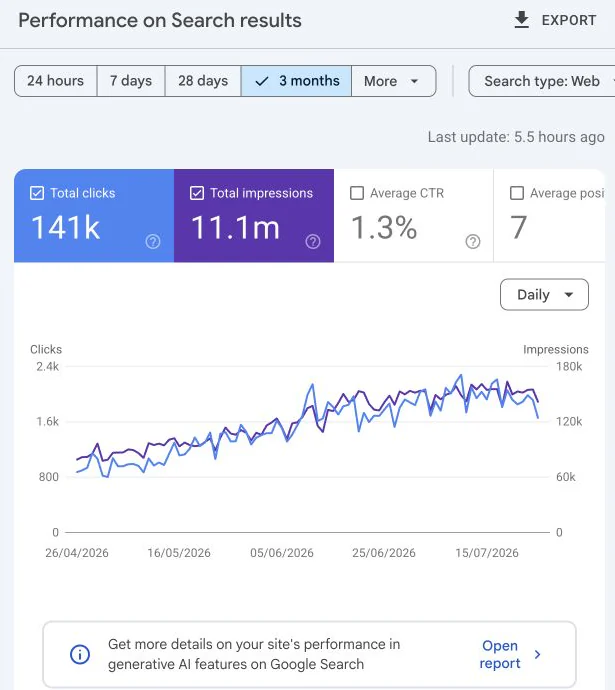
Google Search Console performance for Expressway.PH showing 141 thousand clicks and 11.1 million impressions over three months.
Reporting layer — Google Search Console and organic growthThree months
Captured 28 July 2026

Reserved for an approved report showing platform, prompt panel, observation date, citations, and competing brands.

Ahrefs
Verified capture
Ahrefs AI responses overview for Expressway.PH showing visibility in Google AI Overviews, ChatGPT, Google AI Mode, Gemini, Perplexity, Copilot, and Grok.
Reporting layer — AI mention and citation observationsPoint-in-time visibility snapshot
Captured 28 July 2026

No blended vanity number

Organic performance and generated-answer observations retain their own definitions and sources.

No false precision

Variable answer results are dated observations. They are not presented as permanent positions.

No automatic causality

A release and a later movement are reported together, but causal confidence depends on the available evidence.

Client Work

SEO Case Studies & Results

Approved results from two owned search projects. Each public metric names its source and reporting window; private client work remains private until publication is explicitly approved.

Automotive & Publishing

01

Expressway.PH

Building a Philippine road-information source visible in Google and tracked AI responses

49.2K estimated monthly organic traffic

July 2026 · First-party project owned and operated by the project owner

Reserved for the approved Ahrefs screenshot with Avg. organic traffic selected and the organic keyword trend visible.

Ahrefs
Verified capture
Ahrefs two-year average organic traffic chart for Expressway.PH showing a strong upward trend.
Expressway.PH — Ahrefs organic traffic and keyword trendTwo years · monthly
Captured 28 July 2026

Finance & Utilities

02

TaxCalculator.com.ph

Growing a Philippine tax calculator from a clean Google Search baseline

32.3K GSC impressions in three months

July 2026 · First-party project owned and operated by the project owner

Reserved for the approved three-month Search Console screenshot showing total clicks, total impressions, and the full trend.

Measurement
Visual explainer
TaxCalculator.com.ph — Google Search Console performanceBaseline, observation and decision model
Prepared July 2026

Client testimonials

What clients say about the work

Real client feedback is published only with explicit sign-off.

James Lim

Client Testimonial

We hit our KPIs in less than 3 months. Moved key pages to #1 and #2.

James Lim

CEO, Helpling APAC

We successfully migrated our blog from Medium to Goodnotes.com/blog without losing traffic. We also solved tech SEO problems for the Thailand, Japan, Taiwan, and Hong Kong sites, doubling the traffic with minimal efforts.

Elizabeth Ching

Marketing, Goodnotes

There's not enough room here for me to write about all the amazing things Aditya did for our Workhap website & Marketing team! He's an expert when it comes to everything SEO-related and went above & beyond our initial scope of work. He is someone you can absolutely trust and know has your best interest in mind. 10/10 highly recommend Aditya for all your SEO and marketing needs.

Sho Dewan

CEO, Workhap

Working with Aditya in our journey to rank our website has been a great pleasure. Aditya possesses an exceptional skill set and a deep understanding of SEO strategies and techniques. He has an uncanny ability to analyze complex data and identify critical opportunities to improve organic search rankings and drive targeted website traffic. I wholeheartedly recommend Aditya for any SEO-related position or project.

Caleb Hoon

Head of Community and Operations, OFFEO

I had the pleasure of working with Aditya. He is a true SEO specialist. He knows how to layout the SEO strategy together with a timeline and a list of tasks to be done.

Eyal Gerber

Founder & CEO, Novodes

He helped us with market research, define the right topics along with the content brief and SEO framework. He did an extensive site audit and helped us weed out the loopholes. This helped us scale our traffic and also improved our Google ranking. Aditya was always ready to help and introduced me to a lot of concepts in SEO.

Shubhangi

Content, Adapt.io

Aditya was brought in as a consultant to help my department improve our SEO practices. His advice was invaluable and he was always on hand to answer questions, offer insights, and he gave us a number of great suggestions for SEO tools that would help us in our day to day SEO content production. I can't recommend Aditya's services highly enough. Very professional and reliable throughout our working relationship.

Frederick Jéquier

Senior Content Editor, GoTeamUp

Aditya is highly skilled in SEO and has a strong drive for making positive changes. He has successfully led SEO efforts for GrowthSpot and our clients. I highly recommend him to anyone seeking assistance with SEO.

Randal Hung

Founder, GrowthSpot

SEO Services

Monthly SEO retainers

Ongoing SEO management with transparent deliverables, monthly reporting, and a dedicated team focused on your organic growth.

Initial

01

The starting point for an ongoing engagement concentrated on the highest-priority search constraint.

$3,500/mo
  • Custom scope after diagnosis
  • Google and AI-search research
  • Priority technical or page work
  • Implementation briefs and QA
  • Measurement matched to the goal

Enterprise

03

For large sites, multiple markets, regulated review, migrations, or complex data and governance requirements.

Custom
  • Custom capacity and specialists
  • Multi-market governance
  • Developer and release collaboration
  • Advanced analytics requirements
  • Formal ownership and acceptance tests

Fit and investment

Is TheProjectSEO the right partner for your business?

Ongoing engagements start at $3,500 per month. Scope changes with technical complexity, page production, authority requirements, markets, and access to measurement data.

The proposal identifies what we will deliver, what your team owns, the assumptions behind the plan, and what is not included. Defined audits and implementation projects can be scoped separately.

A strong fit

  • A proven product or service with meaningful discovery demand
  • Access to the website, analytics, and subject-matter experts
  • A team able to approve technical and editorial changes
  • A need to join Google, GEO, data, and implementation
  • A durable growth horizon rather than an instant guarantee

Not the right fit

  • Guaranteed rankings, citations, or revenue are required
  • The goal is unreviewed AI publishing at maximum volume
  • No owner can implement changes on the website
  • Success is limited to a proprietary visibility score
  • The plan depends on fake locations or unsupported claims
An experienced SEO consultant taking notes during a remote strategy session.

Company and locations

Who is accountable for the work, and where do we operate?

TheProjectSEO is led by Aditya Aman, an SEO consultant with practitioner experience across technical optimization, content systems, ecommerce, analytics, and programmatic workflows. The team works across India and the Philippines and uses owned projects to test methods before turning them into client recommendations.

Our dedicated location coverage is intentionally limited to those two countries. We can work with international companies, but we do not create thin city or country pages to imply a local presence that does not exist. Industry pages follow the same rule: a page needs a distinct search problem, useful expertise, and enough depth to deserve its URL.

Teams researching a problem before speaking with us can use our

, including the sourced , practitioner guides, methodology, and approved case studies.

Primary sources

Which official guidance supports this approach?

Provider documentation changes. These links were reviewed on July 27, 2026. Where a platform does not publish a claimed ranking factor, we describe our method as an observation or test—not a fact about the model.

FAQ

AI-native SEO agency questions

An AI-native SEO agency uses artificial intelligence throughout research, analysis, production support, quality control, implementation, and monitoring—not only to draft copy. Search data and defined instructions provide context; automation handles repeatable work; an experienced practitioner remains responsible for strategy, evidence, and release. At TheProjectSEO, the operating system supports conventional organic growth and visibility in generated answers as one connected discipline.
An AI search SEO agency improves how a brand is discovered, described, cited, and recommended in products such as Google AI Overviews, AI Mode, ChatGPT, Perplexity, Gemini, and Claude. That requires more than monitoring prompts. The website must be accessible, the entity must be clear, important questions must be answered, claims need evidence, and independent sources should corroborate the brand.
SEO improves visibility in organic result sets. Generative engine optimization, or GEO, improves the likelihood that source material can support a generated response. Answer engine optimization, or AEO, emphasizes concise, extractable answers. LLM SEO is an informal label for brand visibility in large-language-model products. The terms overlap, so we manage them through one SEO and GEO strategy with platform-specific tests.
No. Google explicitly says its existing fundamentals remain relevant to AI Overviews and AI Mode, and that eligible pages must be indexed and able to appear with a snippet. Other answer products also need accessible sources. Strong GEO therefore begins with sound technical implementation, useful pages, clear internal relationships, and credible authority; it adds answer formatting, evidence design, entity work, and response measurement.
No. A vendor cannot control a platform index, retrieval process, model, prompt interpretation, or generated response. We can improve eligibility and the quality of the available evidence, then measure whether citations and recommendations change. We do not turn a variable observation into a guarantee or claim that one page edit caused every movement.
We use a controlled prompt panel. Each observation records the platform, model where available, prompt wording, market, date, brand appearance, recommendation context, cited URLs, and competing brands. Repeated runs reveal patterns without pretending an answer is a fixed rank. AI referral sessions and conversions are measured separately because a mention, citation, click, and lead are different events.
Not when the intent is the same. This homepage intentionally consolidates the agency-level cluster—AI-native SEO agency, AI-first SEO agency, AI search SEO agency, SEO and GEO agency, GEO SEO agency, and LLM SEO agency—into one substantial entity page. Separate service pages exist only where a visitor needs a distinct scope, process, or platform-specific answer.
No. AI can accelerate corpus analysis, clustering, brief construction, internal-link discovery, QA, and drafting support. It does not establish facts or decide what should be published. Every release should have a user task, source context, useful information, an accountable reviewer, and a place in the site architecture. Pages without those conditions are consolidated, improved, or not created.
Eligibility fixes can be released quickly, but crawling, indexation, authority development, result-set movement, and stable changes in generated answers happen on different timelines. The first 30 days establish the baseline and backlog; the first 90 days provide enough operating evidence to judge implementation velocity and early movement. Durable commercial growth normally requires continued iteration.
Ongoing engagements start at $3,500 per month. The final scope depends on site size, technical complexity, content production, authority requirements, markets, and measurement access. A defined audit or implementation project can be priced separately. The proposal identifies deliverables, responsibilities, assumptions, and what is outside scope before work begins.
The strongest fit is a company with a proven offer, meaningful organic discovery demand, a website it can change, access to subject-matter expertise, and a team prepared to implement. We are particularly useful when technical work, page strategy, analytics, and AI-answer visibility have become disconnected across multiple vendors or internal owners.
Our dedicated location coverage is limited to India and the Philippines. The company is registered in India and the team has direct operating knowledge across both markets. We can serve companies that operate elsewhere, but we do not publish location pages for countries where we cannot demonstrate genuine relevance.

Build one discovery system

Find the gap between being indexed and being chosen.

We will review your organic footprint, AI-answer presence, technical foundation, page architecture, authority, and measurement setup—then identify the highest-value next move.

  • Google and AI-answer baseline
  • Competitor, source, and page gaps
  • Prioritized implementation roadmap
Request a Search Review